News
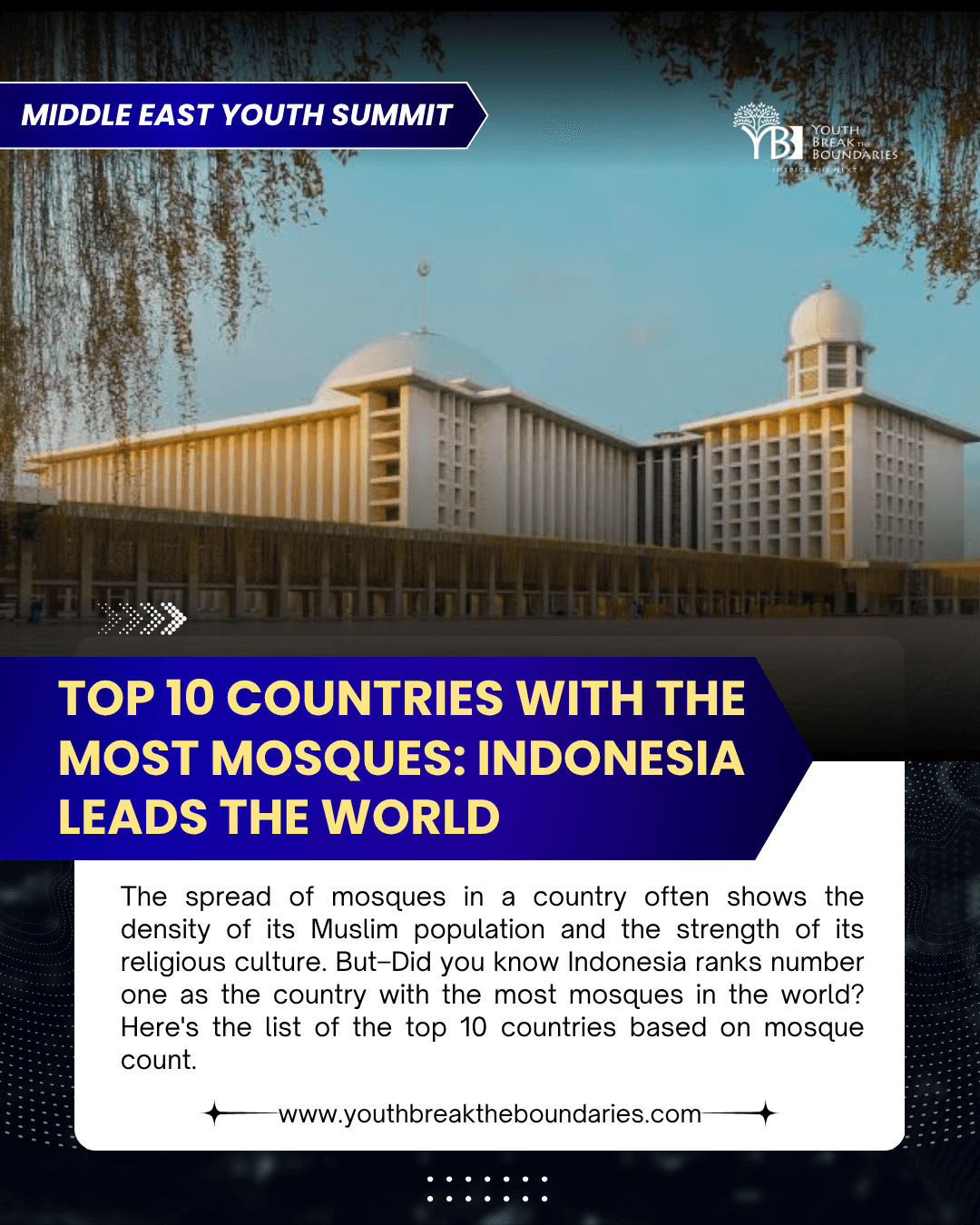
countrieswithmostmosquesmosquestatisticsmiddleeastyouthsummityouthbreaktheboundariesTop 10 Countries with the Most Mosques: Indonesia Leads the World
Middle East Youth Summit 2025 - Jul 29, 2025
Mosques play a crucial role in the lives of Muslims, not only as places of worship but also as centers of social, educational, and cultural life. Mosques aren'…
Full announcement
Mosques play a crucial role in the lives of Muslims, not only as places of worship but also as centers of social, educational, and cultural life. Mosques aren't just buildings—they are centers of community life and social service in many Muslim countries.
The spread of mosques in a country often shows the density of its Muslim population and the strength of its religious culture.
Here's a closer look at the top 10 countries with the most mosques around the world, reported from several sources.
Indonesia
Indonesia has the highest number of mosques in the world with 744,000 registered ones as of July 2025. The Indonesian Ministry of Religious Affairs confirmed this number through the national mosque data portal Simas.
From big cities to small rural villages, mosques are everywhere—sometimes even more than one on the same street.
Istiqlal Mosque is one of the largest and most iconic mosques in Indonesia. Located in Jakarta, this mosque is a symbol of Indonesian independence and unity. Built with magnificent modern architecture, the mosque features a giant dome and minarets.
India
India has over 200 million Muslims. Even though it is not a Muslim-majority country, it takes second place with around 300,000 mosques.
Mosques in India range from historic landmarks to simple prayer halls in local neighborhoods.
Many Indian mosques use red sandstone or white marble, with detailed stonework. Their design blends Persian, Turkish, and Indian styles—seen in domes, arches, geometric patterns. Also floral or column ornaments inspired by both Hindu and Islamic art.
Bangladesh
According to the latest data from Poidata.io (June 2025), there are about 152,241 active mosques in the country.
This high number is due to Bangladesh’s Muslim majority population, a strong tradition of communities building mosques, and government efforts to expand multifunctional mosque networks.
The country's mosque architecture reflects the rich Bengal Sultanate heritage with local touches, alongside modern buildings that express contemporary Islamic spirit and aesthetics.
Mosques in Bangladesh often also function as madrasahs or schools for Islamic studies.
Egypt
According to official data from Egypt’s Central Agency for Public Mobilization and Statistics (CAPMAS), February 2025, there are about 151,194 active mosques.
Mosques in Egypt often serve as centers for preaching, education, and social services. The government uses this mosque network to spread religious teachings and provide community support.
From historic mosques in Cairo to modern cultural centers, the variety of mosque architecture shows the important role of Islam in Egyptian society and national identity.
Al-Azhar Mosque and University remain one of the most respected centers of Islamic learning in the world.
Pakistan
Pakistan has around 100,000 to 110,000 mosques spread across big cities and remote villages, according to Uae Moments. Large mosques like Faisal Mosque in Islamabad also attract thousands of visitors.
From iconic structures like the Faisal Mosque to small local mosques, Pakistan’s architecture reflects a rich historical and cultural heritage.
These mosques are not just places for prayer but also serve as centers for social development, education, and Islamic identity in South Asia.
Sudan
The country has about 78,100 active mosques. Most are found in big cities like Khartoum and Omdurman, as well as rural areas and old towns where around 90% of the population is Muslim.
Mosques in Sudan serve not just as places of worship but also as centers for spirituality, education, and traditional architecture that show the blend of Islam and local culture.
Iran
Although there’s no official national data, trusted sources estimate that Iran has between 55,000 and 75,000 mosques. This makes Iran one of the countries with the most mosques in the world, according to Iran Open Data.
Since the Islamic Revolution, the government has pushed to build many mosques to spread religious teachings and boost the regime’s ideological legitimacy. This led to a sharp rise in mosques, though many are now not actively used.
Interestingly, about 34 mosques, including Jameh Mosque of Isfahan and Shah Lotfollah Mosque, are proposed as World Heritage sites, highlighting the rich Safavid and Qajar architectural styles.
Turkey
Turkey has about 41,883 active mosques as of July 2025, according to the latest data from Poidata.io. It covers all provinces including Istanbul, Ankara, and Konya.
These mosques range from 16th-century buildings to modern multi-functional complexes, showcasing a blend of spirituality, grand architecture, and Turkey’s rich cultural identity.
One of the most iconic is the Hagia Sophia in Istanbul. Famous for its unique mix of Byzantine and Islamic architecture, featuring a soaring dome and beautiful wall decorations.
Marocco
According to the latest data from Poidata.io, Morocco has 20,228 active mosques as of July 2025.
However, government reports suggest the number is higher, around 51,000 to 52,000, with 72% located in rural areas.
Moroccan mosque architecture features rich Moorish, Almohad, and Marinid styles, plus modern designs like the Green Mosque, making mosques both places of worship and cultural symbols of Morocco’s Islamic identity
Nigeria
Nigeria has thousands of mosques, making it one of the countries with the highest mosque counts worldwide. For instance, Osun State alone has around 380 mosques for a population of 2.3 million.
Across Nigeria, mosques are widespread in states with dense Muslim populations such as Kano, Kwara, Yobe, Borno, and Lagos.
The mosques range from iconic structures like the Abuja National Mosque to small community mosques in villages, showcasing a rich and diverse Islamic architectural heritage in West Africa.
Conclusion
Indonesia leads the world with the most mosques—a clear reflection of its Islamic identity and community spirit. Other countries like India, Bangladesh, and Pakistan also show how diverse the Muslim population is globally.
Whether you're traveling or just curious, knowing where mosques are concentrated gives you a glimpse into how Islam shapes different parts of the world.
As global youth become more involved in intercultural experiences, like those offered by the Middle East Youth Summit by Youth Break the Boundaries (YBB), understanding religious and cultural landmarks is more important than ever.